Introduction
Diabetes
in all its forms imposes unacceptably high physical, social and economic burden
on the communities and countries at all income levels. Pre-diabetes is a
serious health condition where blood sugar levels are higher than normal, but
not high enough yet to be diagnosed as type 2 diabetes. Pre-diabetes puts one
at an increased risk of developing type 2
diabetes, heart disease, and stroke [1].
The risk factors for Pre-diabetes
include:
·
Being overweight
·
Being 45 years or older
·
Having a parent, brother, or
sister with type 2 diabetes
·
Being physically active less than
3 times a week
·
Ever having gestational diabetes
(diabetes during pregnancy) or giving birth to a baby who weighed more than 9
pounds
·
Having Polycystic Ovary Syndrome
·
Race and ethnicity (certain races
are more prone)
Diabetes
in the UAE
World Health Organization (WHO)-Diabetes
country profiles, 2016 illustrate that Diabetes accounts to 3% mortality all
ages in the UAE [2]. Figures from the International
Diabetes Federation (IDF) reveal that, in 2017,
17.3% of the United
Arab Emirates (UAE) population between the ages of 20
and 79 had type 2 diabetes. There are over 1 million people living with
diabetes in the UAE, placing the country at 15th place worldwide for
age-adjusted comparative prevalence. Trends also indicate that the prevalence
of diabetes in the UAE is rising at a faster rate than both the MENA region (Middle
East and North Africa region) and the rest of the world. Rapid economic growth,
sedentary lifestyles and unhealthy diets characteristic to the UAE are all risk
factors, leading to the number of people with diabetes expecting to double to
2.2 million by 2040 [3].
Diabetes
in Dubai
Additionally, Dubai Diabetes
Survey conducted by Dubai Health Authority (DHA) in 2017 reported the total
prevalence of Diabetes amongst Emiratis in Dubai is 19%, while the undiagnosed
diabetes cases amongst Emiratis accounts to 11% and the prevalence rate of
pre-diabetes amongst Emiratis is 18.6% [4]. This alarmingly high percentage
undoubtedly represents a worrying indication about the future impact of
diabetes as a major threat in Dubai.
Oral
Health Consequences of Diabetes
Of late, there is an ample
evidence to explain the two-way relationship between diabetes and periodontal
disease. The primary cause of periodontal disease is plaque that contains
pathogenic bacteria that cause inflammation of the gums, leading to the destruction
of tooth-supporting
periodontal tissues. Physiologically active
substances associated with the inflammation are released from periodontal
pockets and then delivered to all parts of the body, where they increase
insulin resistance. Additionally, the hyperglycemic state weakens the immune
function which protects the body from bacterial infection, leading to easy
development and progression of periodontal
disease.
Considering the facts and figures
expressed above, there is a dire need to develop an effective screening tool to
be able assess the risk for diabetes and direct the efforts towards its
prevention across Dubai. Since the natural history for diabetes is well
understood and it is detectable in the preclinical stage, it is wise to devise
a cost-effective, safe and acceptable screening tool that could be easily and
widely used in any environment. Diabetes
risk calculation can be performed by several
health professionals in different settings, of which a dental office could be
an ideal site to carry it out as the former caters to patients of all age
groups with varied medical backgrounds. More so, the nature of dental
treatments mandates multiple visits for most patients, and dental professionals
easily develop a rapport with the patients and thus it is conceived feasible to
administer a simple, chair-side screening tool for diabetes in the dental
offices setting across Dubai. Consequently, if this tool proves accurate and
can detect the affected patients, it will prove very valuable not only to
prevent the progression of active diabetes, but also limit its complications.
On a similar line, the Centers
for Disease Control and Prevention (CDC) also suggest
that the dental office may be a useful setting in which to identify individuals
with undiagnosed Pre-diabetes or diabetes. However, no study has been conducted
so far to estimate the risk for diabetes in the population of Dubai, especially
in a dental setting. This is the first study of this kind in Dubai
Aim
of the study
To detect the individuals who are
at high risk of developing diabetes and correlate with their clinical
periodontal disease status.
Materials
and Methods
A cross-sectional study was
carried out in a primary health center of DHA to assess the risk for diabetes,
using the Finnish Diabetes
Risk Score
(FINDRISC) questionnaire followed by the HbA1c blood
test stipulated only for the patients identified to be at risk. However, the
periodontal examination was carried out for all the patients regardless of the
risk category (Figure 1).
Sample
design and Subjects
A simple random sample of the
population visiting the dental
clinic of Al Mizhar Primary Health Centre was
chosen for this study. Both females and males aged 20-70 years were included
from the morning and afternoon shifts of dental clinics at the above mentioned
health center. Patients sitting in the waiting area of dental clinics were
approached and if found interested, a written consent was given to them to be
signed and the entire procedure was explained. A total of 20 participants
refused to participate, the response rate was 95%. Later, consent forms were
given to a total of 400 participants, out of whom 16 were excluded.
Exclusion
criteria
· Patients
previously diagnosed with diabetes, Pregnant females and
· Patients taking
anti-coagulant medications.
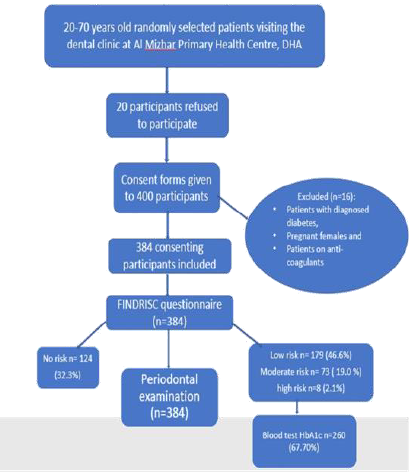
Figure 1:
Flowchart depicting the procedure of sample selection and clinical examination.
Finally,
384 consenting participants were included in the study. The subjects were
screened over a period of 12 months, with 32 patients screened each month,
divided over five days a week (around 6 patients per day) in the dental setting
of Al Mizhir Primary health center, DHA, Dubai. The screening was accomplished
daily based on the availability of the sample with the required criteria.
The
Questionnaire
A
screening chart that was simple, practical, non-invasive and inexpensive namely
FINDRISC was used. FINDRISC has been successfully implemented as a practical
screening instrument to assess diabetes risk and to detect undiagnosed type 2
diabetes in diverse populations.
FINDRISC
questionnaire is a validated risk assessment tool to predict type
2 diabetes. It estimates the probability of a person to develop diabetes within
the next 10 years. It requires no laboratory testing and uses age, Body Mass Index (BMI), physical
activity, vegetable and fruit intake, medical treatment of hypertension,
history of hyperglycemia and family history to determine risk of developing
diabetes [5].
After
procuring the consent forms and completing the registration formalities, each
patient was given a FINDRISC questionnaire (appendix 1), which takes 2-3
minutes to complete. The questionnaire has eight scored questions, with the
total test score providing a measure of the probability of developing type 2
diabetes. The results categorize the participant as high risk, moderate risk,
low risk or no risk individual. Resultantly, patients falling in the no risk
category received a report on their condition and given printed advice and tips
on how to stay healthy (Table 1) [6].
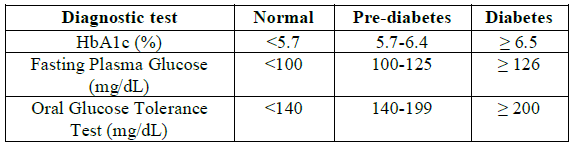
Table 1: CDC
recommendations for Pre-diabetes and diabetes identification.
HbA1c
Blood Test
Next,
patients at the high risk, moderate risk or low risk categories were requested
to take a finger-prick blood sample collection for in-office HbA1c testing with
Metrika A1c Now (Bayer Health Care, Sunnyvale, CA), as rapid one-step test. It
takes five minutes for the results to appear and the reference HbA1c values
were followed as per the CDC guidelines.
Periodontal
Examination and Charting
Five
dentists and five assistants were involved in the examination, which were
trained and calibrated before initiating the data collection. All the patients
attended their usual appointment and a periodontal charting was done for them
after filling out the FINDRISC forms and the blood test. Community Periodontal Index of
Treatment Needs
(CPITN) was used for the periodontal evaluation. Three indicators of
periodontal status are used for this assessment [7]:
· Presence
or absence of gingival bleeding
·
Supra
or sub-gingival calculus
·
Periodontal
pockets-subdivided into shallow (4-5mrn) and deep (6mm or more).
A
specially designed lightweight probe with a 0.5mm ball tip was used, bearing a
black band between 3.5 and 5.5mm from the ball tip.
Sextants: The mouth is
divided into sextants defined by teeth numbers 18-14, 13-23 24-28,38-34, 33-43
and 44-48. A sextant should be examined only if there are two or more teeth
present and not indicated for extraction. When only one tooth remains in a
sextant, it should be included in the adjacent sextant.
Statistical
Analysis:
For the purpose of inter-examiner reliability, the Kappa coefficient (Cohens
Kappa) was used as a measure of agreement between the examiners. 10% of the
sample was extracted and measured and a value of 0.6 was recorded which shows
good agreement.
The
collected data were loaded into Microsoft excel and thereafter proof reading
was done. Statistical analysis was carried out using IBM-SPSS version 24. All
the categorical variables were expressed as proportion and continuous variables
as means and standard deviation. To know the association between socio-demographic factors and FINDRISC
score, HbA1c and periodontal health, the Pearson chi square and contingency
coefficients were used. Pearson correlation was used to figure out the
correlation between FINDRISC score, HbA1c levels and periodontal measurements.
Further, to find out the factors influencing the periodontal charting, regression
analysis was performed keeping the periodontal scores as the dependent
variable. The predicted probabilities were calculated for periodontal scores,
later receiver curve was also drawn to know the specificity and sensitivity of
the periodontal scores based on the predicted probabilities values. The significance
level was fixed at P<0.05 with 95% confidence interval throughout.
Ethical
Approvals:
Approval from Ethical Committee for Scientific Research, Dubai Health Authority
was obtained.
Results
Distribution
of the Study Participants
Out
of a total of 384 subjects interviewed, majority 71.6% (275) were female
participants and 61.2 % (235) were local population. The mean age of the
participants was 38.90 ± 10.74 and a large proportion i.e. 52.9% (203) belonged
to 20-40 years, while 44.55% (171) belonged to 41-60 years age group. In
relation to health conditions of the participants, 87.5% (336) were healthy
individuals (Table 2 and Figure 2).
All
the 384 participants completed the FINDRISC questionnaire, of which 32.3% (124)
participants were categorized as having no risk followed by 46.6% (179)
participants were with low risk of developing diabetes, while 19% (73) and 2.1%
(8) of them were having moderate and high risk of developing diabetes
respectively. Further, a total of 32.3% (124) were exempted from the blood test
as they were at a low risk from the FINDRISC questionnaire and the remaining
participants were tested for serum HbA1c Level. Accordingly,
46.1% (177) participants had normal HbA1c followed by 18.0% (69) and 3.6 % (14)
participants were Pre-diabetic and diabetic respectively. All the participants
were subjected to periodontal charting and it was observed that 19.3% (74)
participants had a pocket measuring more than 4mm and 15.9% (61) had
periodontal pocket measuring more than 6mm (Table 3 and Figure 3).
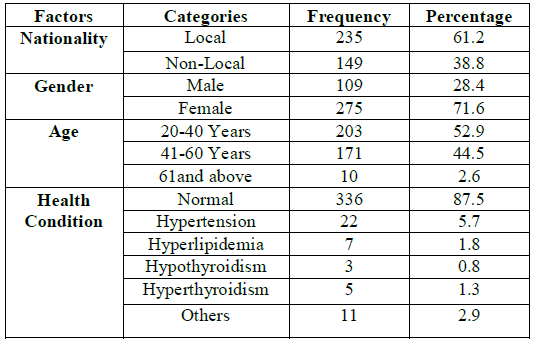
Table 2: Distribution of
the study population according to the demographic factors and health condition.
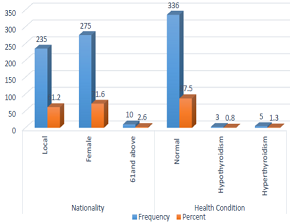
Figure 2: Distribution of
the study participants according to the Demographic factors and health
condition.
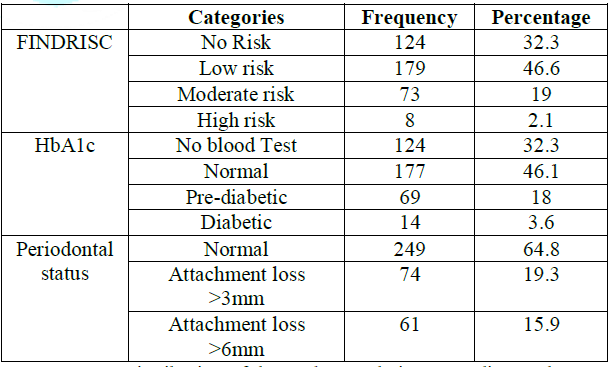
Table 3: Distribution of
the study population according to the FINDRISC, HbA1c and Periodontal Scores.
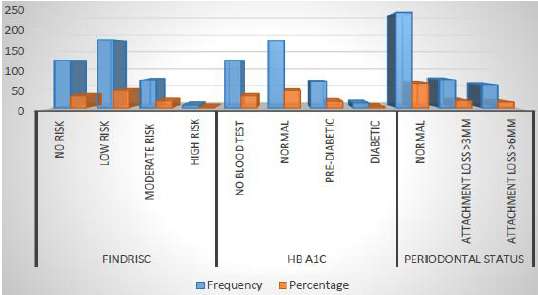
Figure 3: Distribution of
the study participants according to FINDRISC, HbA1c and Periodontal Condition.
Association
between Demographic Factors and FINDRISC Score
With
respect to nationality, local participants had greater scores of FINDRISC
questionnaire as compared to the non-local participants with 52.3% (123) vs.
37.6% for low risk, 19.6% (46) vs. 18.1% (27) for moderate risk and 2.6% (6)
vs. 1.35(2) high risk scores respectively. Also, female participants had a
higher FINDRISC score compared to male participants with 20.4% (56) vs. 15.6%
(17) for moderate risk score, while 2.9% (8) of the females had a high-risk
score whereas no male subjects were found with FINDRISC score of high risk. In terms of
age, higher the age of the participant, greater is the FINDRISC score with 60%
(6), 33.9% (58) and 4.4% (9) of the high-risk score for the 20-40 years, 41-60
years and 61 years and above group respectively.
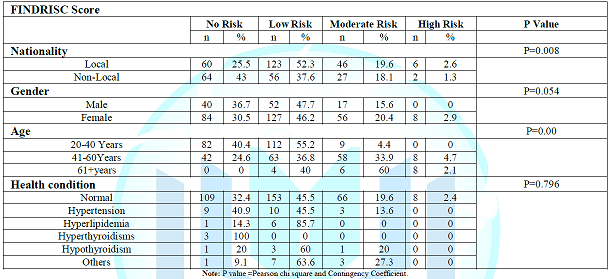
Figure 4: Association
between demographic factors and FINDRISC scores.
Association
of Demographic Factors with Serum Hba1c Levels
The
association of demographic factors with an HbA1c level showed fashion similar
to that of FINDRISC Score. A total of 68.1% (47) and 85.7% (12) of the local
participants had Pre-diabetic and diabetic levels of HbA1c compared to 31.9%
(22) and 14.3% (2) of non-local Participants. Next, 60.9% (42) of the females
were in the Pre-diabetic stage compared to 39.1% (27) of the males. Likewise,
57.1% (8) females and 42.9% (6) males were diabetic stage of HbA1c levels. With
respect to age, 60.9% (42) belonging to 40-60 years were Pre-diabetic compared
to the younger age group which is 34.8% (24), also 85.7%
(12) participants had diabetes level of HbA1c compared to the younger
counterparts 14.3% (2).
The
health condition of the participants again posed no significant association
with the HbA1c level, however, 2 subjects with hypertension and 2 subjects with
hyperlipidemia had Pre-diabetes as measured by
HbA1c (Table 5 and Figure 5).
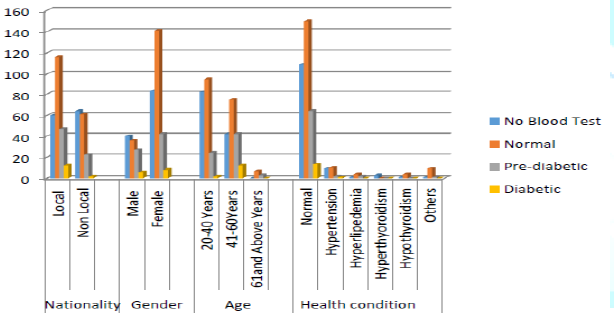
Figure 5: Association
between demographic factors and HbA1c levels.
Association
of Demographic Factors and Periodontal Condition
Among
the subjects having periodontal loss of attachment 82.2% (37) were locals
presenting with periodontal pockets more than 4mm compared to 17.8% (8)
non-locals, similarly 72.5% (29) locals had a periodontal pocket more than 6mm
compared to 27.5% (11) non-locals.
With
respect to gender, a greater number of female subjects were observed with
periodontal pocket more than 4mm 86.7% (39) vs. 13.3% (6). Similarly, pockets
measuring 4mm was found more among the younger adults (20-40) 46.7% (21) vs.
42.2% (19), whereas pockets measuring more than 6mm were more among the older
adults (41-60), 67.5% (27) vs. 32.5% (13) (Table
6 and Figure 6).
Association
of FINDRISC Score, HbA1c Levels and Periodontal Conditions
The
presented revealed that a statistically significant association between the
periodontal condition and find risk scores as 66.7% (30) and 75% (30) subjects
belonging to the low risk group had pockets measuring more than 4mm and 6mm
respectively. Next, 11.1% (5) of the subjects in high risk group had pocket
more than 4mm.
Similarly,
50% (20) of the subjects belonging to Pre-diabetic and 25% (10) subjects
belonging to diabetic stage of HbA1c levels were observed with pockets more
than 6mm. Additionally, 45.8% (127) of periodontally healthy subjects presented
with normal HbA1c levels and 13.7% (38) of periodontally healthy subjects fall
in the Pre-diabetic
HbA1c category.
These observations were statistically significant (Table 7 and Figure 7).
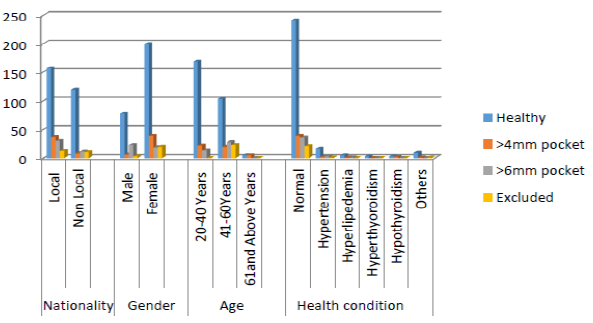
Figure 6: Association
between demographic factors and periodontal condition.
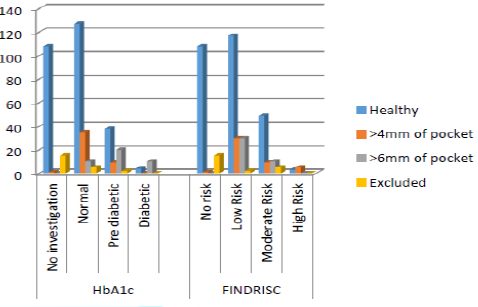
Figure 7: Association
between FINDRISC score, HbA1c level and periodontal condition.
Accuracy
of Periodontal Measurement
Using
the regression model, the sensitivity and specificity periodontal diagnostic
was assessed for the periodontal condition which showed 76.4% sensitivity and
82.01% of specificity. In addition, Area Under curve was measured using
predictive probabilities of logistic regression for periodontal condition using
receiver operating curve that showed a significantly good accuracy of
periodontal measurement (Table 8).
Relationship
between FINDRISC, HbA1c and Periodontal Scores
Further,
a correlation matrix was established using the continuous scores of FINDRISC,
HbA1c level and predicted probability of periodontal scores. The correlation
matrix showed significant relationship between these three variables (Table 9).
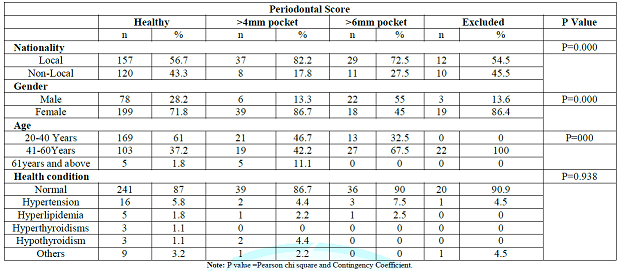
Table 6: Association
between the demographic factors and Periodontal Condition.

Table 7:
Association between the FINDRISC score, HbA1c Level and Periodontal condition.
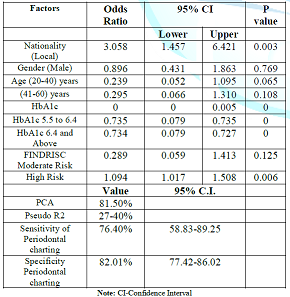
Table 8: Regression
analysis for periodontal conditions and nationality, age, gender HbA1C and
FINDRISC scores.

Table 9: The
Correlation matrix between FINDRISC, HbA1c and Predictive probabilities of
periodontal condition.
Discussion
Findings
from the present study suggest a potential correlation between FINDRISC, HbA1c
level and predicted probability of periodontal scores. Emirati participants and females
posed a higher risk for diabetes. Female participants presented with more and
deeper periodontal pockets too. All the high-risk participants belonged to a
higher age group. It was also discerned that statistically significant
association exists in terms of nationality, gender and age with FINDRISC score
and the diabetic stage. However, the health condition of the participants in
this study was found to have no significant association either with the HbA1c
level or with the periodontal condition.
Almost
two-thirds (67.7%) of the participants in this study were found to have low,
moderate or high risk for diabetes and nearly a fifth of the surveyed
population posed higher HbA1c levels indicating pre-diabetic or diabetic
stages. An alarming proportion i.e. more than a fifth of the study sample
(21.6%) were discovered to be either pre-diabetic or diabetic. Further, of all
the pre-diabetic individuals, more than two-thirds (68.1%) were UAE nationals
and likewise even amongst the diabetics, a majority (85.7%) were UAE nationals
again. A potential explanation for this skewed distribution could be that due
to the location of the study was a DHA health center where majority of the
patients-cohort is formed by UAE nationals and very few non-nationals, that
automatically justifies an overall higher prevalence of these conditions
amongst them.
It
is noteworthy that occurrence of diabetes was noticed in 3.6% of the study
participants, which is much lower than the corresponding value outlined in the
USA, UK and Australia being 9.4% 9, 6.6% and 6% respectively, as reported by
their national statistics [8,9,10]. Further, in the present study, 20% of the
participating Emiratis were found to be pre-diabetic, which is slightly higher
than reported by Dubai Diabetes
Survey
conducted by DHA in 2017 (18.6%) [4]. In contrast, the rate of diabetic Emiratis
in this study is only 5.1% which is clearly much lower than the Dubai survey
(19%). The prevalence of pre-diabetes in the present study (18%) was slightly
lower than that reported by S Maples et al. (19.2 %) and higher than that
reported by National Health
and Nutrition Examination Survey (NHANES) (17.31%) [11,12]. At the same
time the diabetes percentage in the present study (3.6%) was observed to be
higher than reported by S Maples et al. (1.2%) and NHANES (1.64%). Al Amiri et
al. reported the prevalence of prediabetes, among overweight and obese Emirati
children and adolescents in Sharjah as 5.4% and 0.87%, respectively, based on Oral Glucose Tolerance Tests (OGTT), which
are much lower than the present study [13].
Unlike
certain other studies, the present study revealed significant gender
differences in the FINDRISC scores as well as HbA1c values with P=0.054 and
P=0.008 respectively, these findings contrast the ones obtained by S Maples et
al, and W.H. Herman et al, where no significant gender differences were noticed
in the pre-diabetes and diabetes prevalence. Identical to the findings from the
NHANES and S Maples et al, age was seen to be significantly associated with the
presence of diabetes and pre-diabetes in the present study (P=0.00) [11,12,14].
The
findings of this study were consistent with the Wijnand J Teeuw et al, where
statistically significant association was found between the HbA1c levels and
the periodontal status, and significantly greater number of subjects were
spotted with deep pockets (more than 6 mm) in the pre-diabetic and diabetic
groups as compared to the subjects with normal HbA1c levels (Table And Figure 8). The present study
also indicates a highly significant association between the periodontal
condition and risk for diabetes and the diabetic stage the p value being
P=0.000, which is inconsistent with certain other studies such as Oelisoa
Mireille et al. who found no significant association between fasting glucose
and bleeding on probing [15,16].
There
has been abundant evidence to support that the presence and severity of
periodontal disease is highly associated with the diabetic stage and its
complications. Severe periodontitis has been found to be associated with poor glycemic
control after a 5-year period and subjects with Clinical Attachment Loss (CAL) of at
least 6 mm had over six times the risk of poor glycemic control compared to
those without it [17]. Additionally, an increase in mean CAL has been
associated with an increase in HbA1c. Next, a significant increase in Impaired Glucose Tolerance (IGT) with mean Periodontal
Probing Depth (PPD), with each additional millimeter mean PPD corresponding to
0.13% increase in HbA1c has been observed after 10-year follow-up [18]. Later,
all studies in subjects with types 1 and 2 diabetes found that those with
periodontal disease, especially severe disease, and edentulism, had higher risk
for diabetes-related complications than participants without or with mild periodontal disease [19]. Lastly,
severity of periodontal disease expressed by clinical attachment loss at
follow-up was significantly associated with development of diabetes over ten
years in a study [18]. However, due to their design and nature, cross-sectional
studies are limited to only provide information about associations and are thus
not able to an establish a causal relationship.
Limitations
of the Study
· The small sample
size of this study defers the extrapolation of the results to whole of Dubai population.
· No information
around smoking (duration and frequency) has been recorded, since smoking is a
known risk factor for periodontitis and plays a significant role in aggravating
the complications caused due to diabetes, it would have been beneficial to do
so.
Recommendations
· In light of the
findings of this research, the routine application of the FINDRISC tool in the
dental setting for the purpose of risk assessment and screening for diabetes and Pre-diabetes is highly
recommended.
· It will be more
beneficial if information about smoking is also recorded along with other risk
factors, since it is a well-known risk factor for periodontal disease and at
the same time aggravates the complications caused due to
diabetes.
· Non-dental health
care providers should be well informed about these results and made aware of
the two-way relationship of diabetes and periodontal health to be able to
collaborate with them for the purpose of early detection and prevention of the
diabetes. The two primary goals of management of Pre-diabetes are lifestyle
management to prevent the progression to type 2 diabetes and management of
common Pre-diabetes comorbidities, both of which requires the effective
contribution of the abovementioned stakeholders [20].
· The confirmation
of the blood glucose by other standardized measurements such as OGTT and
fasting blood glucose levels along with their clinical correlation would be
ideal before initiating any discrete treatment for the diabetic patients, due
to the reported overestimation of the blood glucose levels by the HbA1c [21,22].
Conclusions
The
Diabetes Risk Score has proven to be very useful in identifying high-risk subjects
and exhibits worrying high proportion of Pre-diabetes and diabetes among Dubai
population. Filling in the Diabetes Risk Score may encourage a person who gets
a high value to have his/her blood glucose measured and also to improve their
lifestyle regardless their glucose levels. Additionally, many individuals with
a high Diabetes Risk Score may have unrecognized, asymptomatic diabetes and,
therefore, may require blood glucose testing for diagnosis, other clinical
assessments, and therapy.
This
study emphasizes that periodontal disease adversely affects glucose levels and
promotes development of Pre-diabetes and diabetes and vice-versa. The results
obtained here would affect the patients and families, health care providers,
insurance companies, policy-makers and societies in general, due to the high
prevalence of both periodontal disease and diabetes in Dubai
afflicting immense physical, mental, social and economic consequences. Controlling
and managing periodontal disease could be a new aspect to eventually include in
the standards for diabetes care. It undoubtedly requires a shift in paradigm
for management and prevention of diabetes and its complications. Dental setting could be
successful platform to carry out the screening and risk stratification of
diabetic patients, those could further be referred to the relevant medical
provider for subsequent treatment and follow up.
Acknowledgments
The
authors would like to thank Dr. Ghayath Aboud, Dr. Vijitha Saleem, Dr. Sameh
Sulaiman and Dr. Darwish Al Sadik for their valuable input in the data
collection process.
References
1.
Prediabetes:
Your Chance to Prevent Type 2 Diabetes
2.
World Health
Organization-Diabetes country profiles (2016) United Arab Emirates
3. Ogurtsova
K, da Rocha JD, Huang FY, Linnenkamp U, Guariguata L, et al. IDF Diabetes
Atlas: Global estimates for the prevalence of diabetes for 2015 and 2040 (2017)
Diabetes Res Clin Practice 128: 40-45. https://doi.org/10.1016/j.diabres.2017.03.024
4.
2nd Phase of
Dubai Diabetes Survey Results Revealed (2017) Dubai
5.
Maurice
vandersmissen JG and Godderis L. Evaluation of the Finnish Diabetes Risk Score (FINDRISC)
for diabetes screening in occupational health care (2015) Int J Occupational Med Environmental
Healt 28: 587-591. https://doi.org/10.13075/ijomeh.1896.00407
6.
Lindström
J and Tuomilehto J. The diabetes risk score: a practical tool to predict type 2
diabetes risk (2003) Diabetes Care 26: 725-731. https://doi.org/10.2337/diacare.26.3.725
7.
Point-of-care
prediabetes identification, American Medical Association
8.
National Diabetes
Statistics Report (2017) Estimates of Diabetes and Its Burden in the United
States, USA
9.
Diabetes and a
lot of facts and stats, United Kingdom
10.
Diabetes snapshot
(2019) Australian institute of health and welfare
11.
Maples
S, Aldasouqi S, Little R, Baughman H, Joshi M, et al. Detection of Undiagnosed
Prediabetes and Diabetes in Dental Patients: A Proposal of a
Dental-Office-Friendly Diabetes Screening Tool (2016) J Diabetes Mellitus 6:
25-37. https://doi.org/10.4236/jdm.2016.61004
12.
Estrich
CG, Araujo MWB and Lipman RD. Prediabetes and Diabetes Screening in Dental Care
Settings: NHANES 2013 to 2016 (2019) JDR Clin Trans Res 4: 76-85. https://doi.org/10.1177/2380084418798818
13.
Al
Amiri E, Abdullatif M, Abdulle A, Al Bitar N, Afandi EZ, et al. The prevalence,
risk factors, and screening measure for prediabetes and diabetes among Emirati
overweight/obese children and adolescents (2015) BMC Pub Healt 15: 1298. https://doi.org/10.1186/s12889-015-2649-6
14.
Herman
HW, Taylor GW, Jacobson JJ, Burke R and Brown MB. Screening for prediabetes and
type 2 diab etes in dental
offices (2015) J Pub Healt Dentistry 75: 175-182. https://doi.org/10.1111/jphd.12082
15.
Teeuw
WJ, Kosho MXF, Poland DCW, Gerdes VEA and Loos BG. Periodontitis as a possible
early sign of diabetes mellitus (2017) BMJ Open Diabetes Res Care 5: e000326. https://doi.org/doi:10.1136/bmjdrc-2016-000326
16.
Andriankaja
MO and Joshipura K. Potential association between prediabetic conditions and
gingival and/or periodontal inflammation (2014) J Diabetes Invest 5: 108-114. https://doi.org/10.1111/jdi.12122
17.
Borgnakke
WS, Ylostalo PV, Taylor GW and Genco RJ. Effect of periodontal disease on
diabetes: systematic review of epidemiologic observational evidence (2013) J
Clin Periodontol 40: S135-S152. https://doi.org/10.1111/jcpe.12080
18.
Saito
T, Shimazaki Y, Kiyohara Y, Kubo IK, Iida MM, et al. The severity of
periodontal disease is associated with the development of glucose intolerance
in non-diabetics: the Hisayama study (2004) J Dental Res 83: 485-490. https://doi.org/10.1177/154405910408300610
19.
Shultis
WA, Weil EJ, Looker HC, Curtis JM, Shlossman M, et al. Effect of Periodontitis
on overt nephropathy and end-stage renal disease in type 2 diabetes (2007)
Diabetes Care 30: 306-311. https://doi.org/10.2337/dc06-1184
20.
Management of Prediabetes,
American association of clinical endocrinologists
21.
When is
hemoglobin A1C inaccurate in assessing glycemic control?
22.
Radin
SM. Pitfalls in Hemoglobin A1c Measurement: When Results may be Misleading
(2013) J Gen Intern Med 29: 388-394. https://doi.org/10.1007/s11606-013-2595-x
*Corresponding author
Shiamaa
AlMashhadani, Specialist Senior Registrar Dental Public Health specialist, Dubai
Health Authority, United Arab Emirates, Tel: 00971551038706, E-mail: ssalmashhadani@dha.gov.ae
Citation
AlMesmar
H, Saleh N, AlMashhadani S
and Farghali K. The detection of pre-diabetic patients
in the dental setting (2019) Dental Res Manag 3: 56-63